
Fundamentals. Installed deliberately.

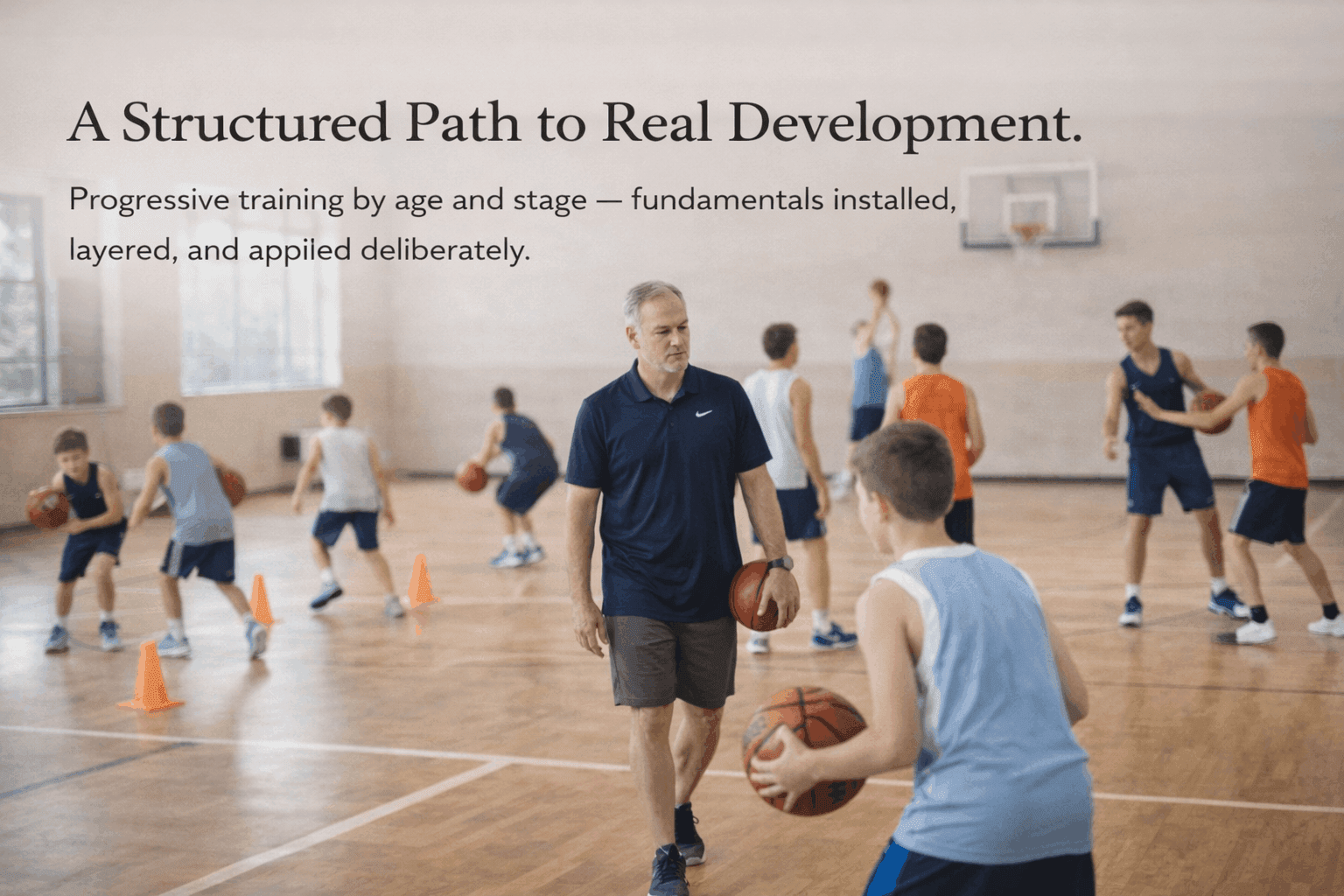
Eastside Development Academy operates on a written, progressive curriculum.

Development is not random.

Each age band follows a structured sequence built around:

  • Mechanical precision
  • Repetition density
  • Decision awareness
  • Emotional composure
  • Long-term compounding


We do not rush phases.

We layer them.

The Development Framework

EDA is built around three progressive stages:

  • Foundation (Ages 8–10)
  • Structure (Ages 11–13)
  • Application (Ages 14–16)


Each stage builds on the one before it.

Competition is sequenced.Mechanics come first.

Foundation Cohort (Ages 8–10)

Identity + Movement Literacy

Primary Objective:Build confidence, coordination, and correct early mechanics.

At this stage, the goal is simple:

“I am someone who plays basketball.”

We prioritize:

Movement Literacy
  • Balance and body control
  • Jump and landing mechanics
  • Change of direction
  • Stopping and pivoting


Basketball skill sits on top of movement.

Ball Mastery
  • Stationary dribble series
  • Eyes-up control
  • Weak-hand development
  • Ball protection basics


Repetition volume is high.
Speed is added gradually.

Shooting Fundamentals
  • Proper base alignment
  • Guide hand placement
  • Controlled release
  • Close-range form shooting


No rushed three-point attempts.
No range before mechanics.

Finishing Mechanics
  • Proper layup footwork (both sides)
  • Extension and angle control
  • Off-foot introduction
Emotional Focus
  • Mistakes treated as instructional
  • Calm correction
  • Effort protected

The goal at this stage is stability and joy.

Structure Cohort (Ages 11–13)

Mechanical Installation + Decision Awareness

Primary Objective:Stabilize mechanics and introduce controlled pressure.

This is the stage where most programs skip steps.

We slow down before speeding up.

Shooting Progression
  • Base stabilization
  • Guide hand control
  • Release consistency
  • Catch-and-shoot footwork
  • One-dribble pull-up mechanics


We track mechanics — not just makes.

Ball Handling Progression
  • Weak-hand control at game speed
  • Change of pace
  • Hesitation and counter moves
  • Directional attack


Control precedes creativity.

Layup & Finishing Series
  • Strong-hand and weak-hand finishes
  • Contact preparation
  • Angle reading
Defensive Foundations
  • Stance and slide mechanics
  • Closeout technique
  • Help-side awareness
  • Communication fundamentals


Defense is taught mechanically — not emotionally.

Spacing & Decision Awareness
  • Why spacing matters
  • When to pass
  • When to cut
  • Movement without the ball


Small-sided games introduce structured decisions.

Emotional Focus
  • Correction remains calm
  • Composure under mild pressure
  • Emotional recovery after mistakes


Intensity increases.
Volatility does not.

Application Cohort (Ages 14–16)

Skill Transfer + Composure Under Pressure

Primary Objective:
Transfer mechanics into structured competitive environments.

At this stage:

Pressure is layered intentionally.

Shooting Under Movement
  • Off-screen footwork
  • Transition pull-ups
  • Shot preparation timing
Advanced Ball Handling
  • Change-of-direction counters
  • Defensive reads
  • Pace manipulation
Defensive Application
  • Team positioning
  • Rotations
  • Recovery mechanics
  • Communication accountability
Situational Play
  • Structured scrimmage constraints
  • Shot clock simulation
  • Decision timing


Winning is not the primary metric.

Execution quality is.

Emotional Focus
  • Composure under stress
  • Role acceptance
  • Coachability


Elite aspirations require emotional durability.

The 12-Week Development Block

Each cohort moves through three phases:

Phase 1 — Installation (Weeks 1–4)

Slow down. Stabilize mechanics. Increase repetition clarity.

Phase 2 — Compounding (Weeks 5–8)

Add pace. Add movement. Maintain precision.

Phase 3 — Application (Weeks 9–12)

Transfer skills into structured decision environments.

Sequencing matters.

Session Architecture (Every Session)

Every training session follows the same structure:

  • Regulation + Warm-Up
  • Movement Block
  • Core Skill Installation
  • Applied Progression
  • Structured Small-Sided Play
  • Debrief


Consistency builds safety.

What We Measure

We do not measure wins.

We measure:

  • Shooting base stability
  • Weak-hand proficiency
  • Footwork efficiency
  • Defensive mechanics
  • Decision clarity
  • Emotional recovery time


Athletes receive periodic development feedback.

Specific.
Instructional.
Clear.

Long-Term Development

Eastside Development Academy is built for the long horizon.

Athletes may compete elsewhere.

EDA installs the foundation that allows them to:

  • Enter tryouts prepared
  • Adapt to roles
  • Handle pressure
  • Sustain growth
  • Protect their love of the game


Development before exposure.

Foundation before spotlight.